Smart Sensing
Pick it up, and the screen tells its story. See who comes in, where they stop and what they pick up.

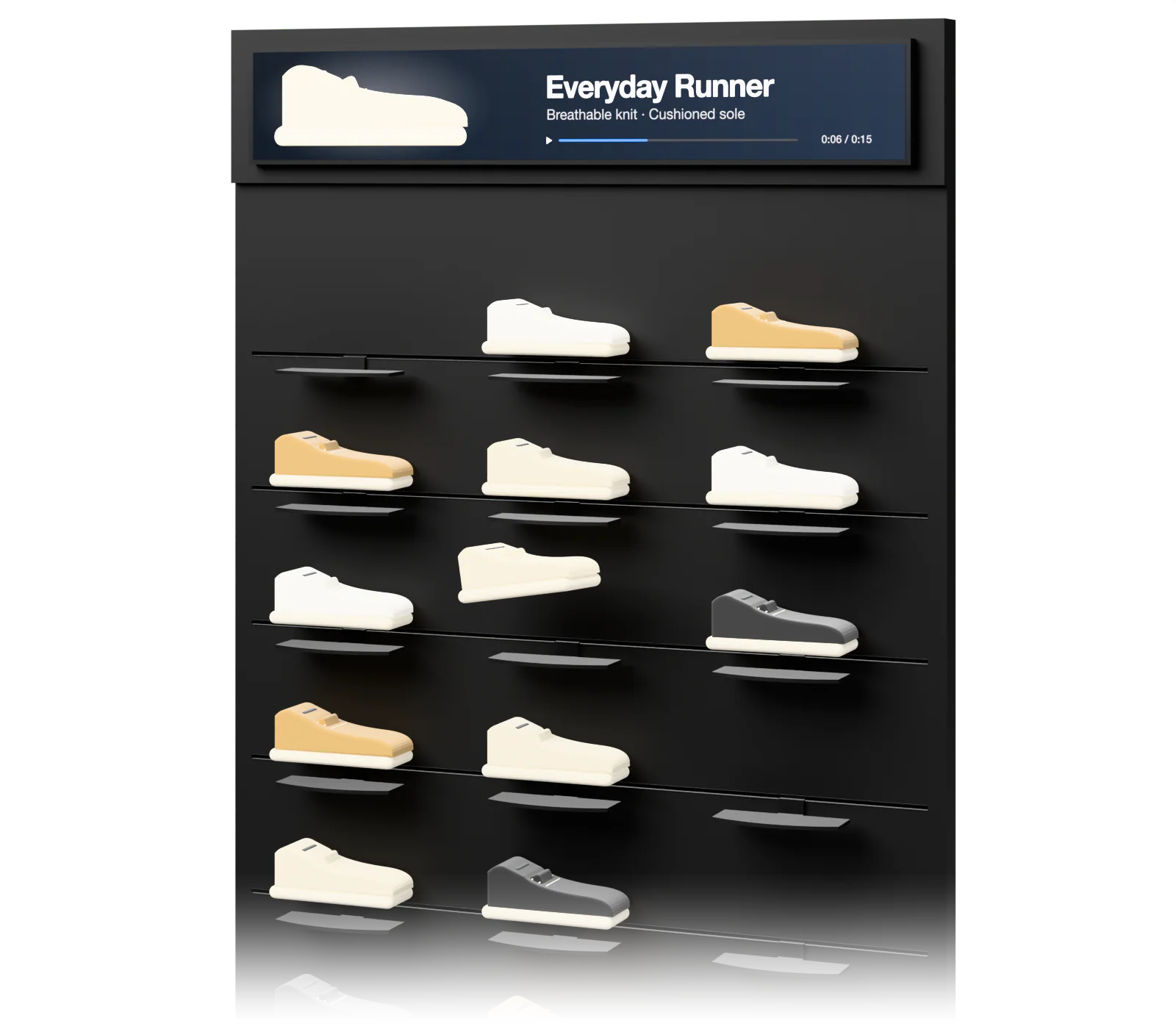
Screen: brand film on loop
Rendered preview. Screen content for illustration.
Lift to play
Pick up a pair. The screen tells its story.
Each holder has a sensor. When a shopper picks up a pair, the screen above plays that style’s video and key points — and goes back to your brand film when the pair is put back.
A shopper picks up a pair
The holder notices the lift.
The sensor signals
No buttons, no app.
The screen plays its story
Video, features or price.

Every position, its own story
The screen knows which pair was picked.
Each holder is matched to a style, so every position on the wall plays its own content. When the range changes, match the positions to new content.
No buttons and no app — shoppers simply pick up and put back.
Feature displays. Helmets, bags or balls on a display stand play when lifted.
Hook displays. Accessories on hooks can trigger content too.
People counting
Who came in. Where they stopped. What they picked up.
A sensor over the door counts visitors in and out. Sensors on the fixtures record how many people stop in front and which products get picked up — all in one dashboard.
Visitors1,286+8% on last week
Stops at fixtures412visits
Lifts168times
Lift rate41%lifts ÷ stops
Visitors by hour
10:0016:0021:00
Most picked up
- Shoe wall A · row 3, middle37
- Shoe island · left face29
- Helmet display21
Visitors. By hour and by day, store by store.
Stops and dwell time. Which fixtures make people stop, and for how long.
Lifts by position. Which positions and styles are picked up most.
Lift rate. Lifts divided by stops: is the display working?
Counts people. Never films them.
The sensors measure distance and movement — no photos, no video, no face recognition, and nothing collected from shoppers’ phones. The dashboard shows numbers, not people.
Built into the fixture. Delivered with it.
Sensors, screens and cabling are planned with your fixture layout. The modules are designed and delivered with the fixtures, and the cables stay inside them.
Tell us about the store.
Store type, fixtures and which positions should play content.
Choose the functions.
Lift to play, people counting, or both.
Test a sample.
Try it in your store first — the sample fee is credited to the order.
Build and ship.
Sensor modules and screens are designed and delivered with the fixtures.
Sensing functions, screen sizes, power specifications and certifications for your market are confirmed in the quotation. Fixtures can be prepared for sensors and screens added later.
Made for how you sell. Footwear, sports and apparel.
Shop by industry


Pilot stores
Five pilot stores. Be one of them.
We are looking for five stores to run lift-to-play and people counting first — and to help us get it right.
Who it’s for. Footwear, sports & outdoor and apparel stores, in China or overseas.
What you get. Lift-to-play and people counting before anyone else, with the positions and content planned together with our team.
How to apply. Tell us your store type, city and roughly how many fixtures. We will get in touch.
Five places in the first group. Pilot terms and costs are agreed when we talk. Just want a quote for now?